Clinical Uses
Where Could DAMNIT-V Help in Practice?
ROUTINE CHECKUPS
The everyday case – screening for subtle changes before they occur physically
POST DESEXING
Screening for HPG, pain, and drug reactions post-desexing to limit Cranial cruciate disease post-desexing.
VAGUE OR EARLY PRESENTATIONS
“Something isn’t right, but I don’t yet have enough information.”
Use DAMNIT-V as an additional screening layer to identify areas that may deserve closer investigation.
RECURRENT CASES
“We’ve treated this before. Why does it keep coming back?”
Review the patient more broadly and look for functional response patterns that may suggest another avenue of investigation.
MULTISYSTEM CASES
“These findings don’t fit neatly into one body system.”
Bring dermatological, gastrointestinal, neurological, metabolic, nutritional and other findings into the same clinical picture.
LARGE DIFFERENTIAL LISTS
“There are ten things this could be. Where do I begin?”
Use functional screening alongside the history and examination to help prioritise which possibilities warrant conventional investigation.
PREVIOUS TESTS HAVEN’T EXPLAINED THE CASE
“The results aren’t normal — but they don’t explain the whole patient.”
DAMNIT-V provides another information layer that can be compared with existing pathology, imaging and clinical findings.
SPECTRUM OF CARE
“We can’t investigate everything today.”
Where resources are limited, prioritisation becomes particularly important.
DAMNIT-V can support the veterinarian in deciding which investigative direction may provide the greatest clinical value first.
What Might This Look Like in Practice?
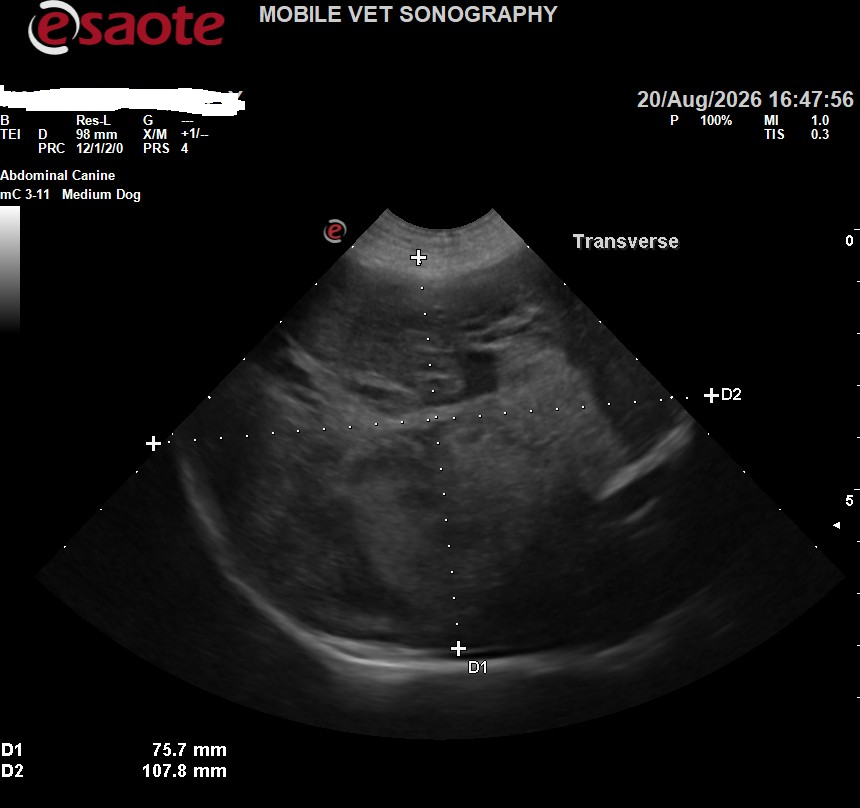
Ultrasound
A mass has been identified, but the patient may be too old or frail to undergo biopsy, or the procedure may be financially out of reach.
You still want information that can help you support the patient.
For example, screening may identify a nausea-associated signal linked with the liver mass. Understanding what may be contributing to the nausea can give the clinician additional information to guide symptom management and supportive care.
This may help inform which treatments or medications are most appropriate for improving the patient’s comfort and quality of life, even when a definitive diagnosis through biopsy is not possible.

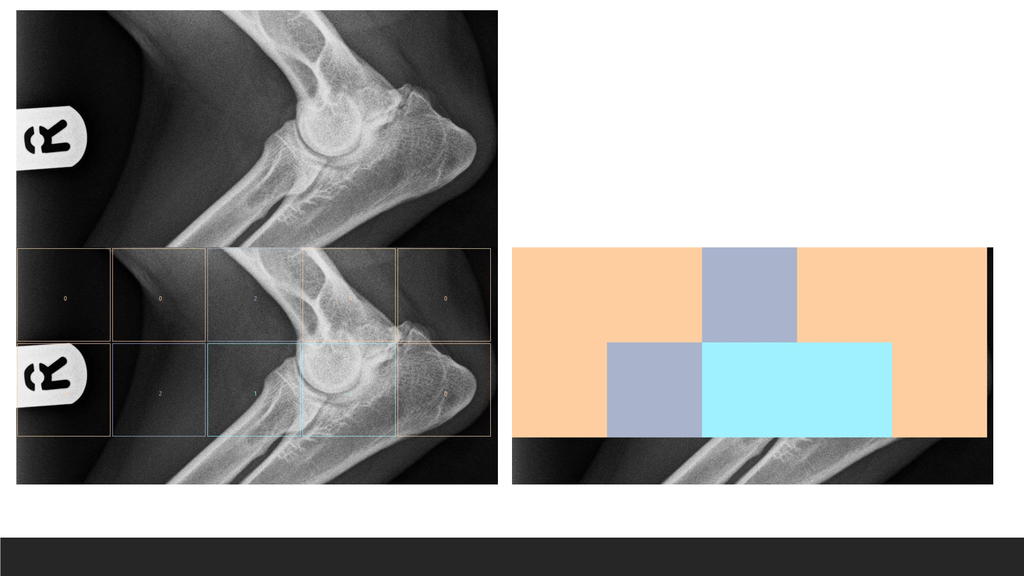
Xray
Is there pain associated with these findings? Pain signal can be checked
Dermatology
Clinical question
Is this primarily a local skin problem, or should I be looking more broadly?
The patient may present with pruritus, alopecia, recurrent otitis or chronic inflammatory skin disease.
DAMNIT-V screening can be considered alongside the dermatological examination to identify functional responses that may justify investigating areas such as:
environmental exposure • nutrition • inflammatory processes • immune processes • metabolic factors
It does not diagnose allergy or identify a causative allergen.
It helps generate questions that can subsequently be tested.
Gastrointestinal Disease
Clinical question
Why does this patient keep having gastrointestinal signs?
Useful where vomiting, diarrhoea, altered appetite or recurrent gastrointestinal disease has multiple plausible explanations.
DAMNIT-V can contribute functional information that is reviewed alongside:
diet • medications • infectious disease • inflammatory disease • metabolic disease • pathology • imaging
The objective is to identify which avenue deserves investigation.
Collapse & Weakness
Clinical question
What needs to be considered urgently?
Collapse may have cardiovascular, neurological, metabolic, toxicological, haematological or other causes.
DAMNIT-V may provide additional screening information during the initial assessment.
It does not replace emergency stabilisation or established diagnostic protocols.
Chronic Pain
Clinical question
Where is the clinical problem coming from?
Pain behaviour does not always identify its origin.
Functional screening can provide another source of information to consider alongside physical examination, neurological assessment and diagnostic imaging.
Neurological & Behavioural Presentations
Clinical question
Is there more contributing to this presentation than behaviour alone?
Changes in behaviour, anxiety, altered responsiveness or unusual neurological signs can have many possible explanations.
DAMNIT-V can support a broader investigation of relevant physiological systems and pathways while conventional neurological and behavioural assessment remains essential.
Complex & Unclear Cases
Clinical question
“What am I missing?”
This may be where DAMNIT-V has its greatest potential utility.
When history, examination and previous diagnostics do not produce a coherent explanation, DAMNIT-V provides another structured way of interrogating the case.
The objective is not to produce another diagnosis.
It is to produce a better question.
Real Cases
CASE 1 — Chronic Pruritus
The problem
A small dog presented with pruritus and alopecia affecting the caudal third of the body.
Conventional investigation included skin examination, dermatological testing and thyroid assessment.
What DAMNIT-V added
Functional screening produced a response pattern that raised the relevance of environmental/contact exposure.
What happened next
The patient’s environment was reviewed and rubber-based contact materials were removed.
Outcome
The lesions resolved and hair regrew.
A single dose of symptomatic Cytopoint® therapy was used.
What this case demonstrates
Screen → clinical question → intervention → outcome
The screen did not diagnose an allergy.
It helped identify an avenue worth investigating.
CASE 2 — Persistent Thrombocytopaenia
The problem
A Cavalier King Charles Spaniel had persistent thrombocytopaenia.
Ten months later the patient also had Grade 4 dental disease but maintained a normal PCV and had no clinical evidence of excessive haemorrhage.
What DAMNIT-V added
Screening included investigation of relevant platelet and genetic pathways.
A strong response was recorded to a test signal representing the canine TUBB1 p.D249N variant associated with congenital macrothrombocytopenia in Cavalier King Charles Spaniels.
The clinical question became
Could this platelet count represent inherited macrothrombocytopenia rather than an acquired bleeding disorder?
What happened next
The dog proceeded to general anaesthesia and four dental extractions with minimal to no abnormal bleeding.
Independent genetic testing subsequently reported:
Congenital Macrothrombocytopenia — POSITIVE (P/P)
Two copies of the TUBB1 variant were detected.
What this case demonstrates
Screening observation → hypothesis → independent confirmation
The DAMNIT-V response was not itself considered proof of the mutation.
The genetic test provided confirmation.
CASE 3 — Acute Collapse
The problem
A patient presented with sudden collapse and weakness.
Potential differentials included:
snake envenomation • tick paralysis • other toxicities • neurological and metabolic causes
What DAMNIT-V added
Early screening indicated toxicological relevance and helped prioritise the toxin investigation.
Clinical role
The finding contributed to early clinical direction while standard emergency assessment and treatment protocols continued.
What this case demonstrates
In an acute presentation, the potential value is not replacing emergency diagnostics.
It is:
reducing the time spent looking in the wrong direction.
The Same Principle Across Different Cases
| Presentation | The clinical question | DAMNIT-V’s role |
|---|---|---|
| Chronic pruritus | Local or systemic? | Identify investigative directions |
| Recurrent otitis | Primary or secondary? | Broaden the clinical question |
| Gastrointestinal disease | Diet, inflammatory, infectious or metabolic? | Prioritise areas for investigation |
| Collapse / weakness | What requires urgent attention? | Additional early screening information |
| Chronic pain | Where might the problem originate? | Support examination and investigation |
| Neurological / behavioural | Behavioural or physiological contribution? | Broaden investigation |
| Complex case | What am I missing? | Reduce diagnostic scatter |
What DAMNIT-V Contributes
DAMNIT-V sits before confirmation in the clinical pathway.
PRESENTATION
What is happening to the patient?
↓
SCREEN
Where are functional responses occurring?
↓
PRIORITISE
Which findings deserve investigation?
↓
INVESTIGATE
Use appropriate conventional diagnostics.
↓
CONFIRM
What does the independent evidence show?
↓
OUTCOME
What happened to the patient?
What It Does — and What It Doesn’t
DAMNIT-V CAN
✓ provide additional functional screening information
✓ help prioritise clinical investigation
✓ support structured clinical reasoning
✓ integrate with pathology and imaging
✓ support longitudinal case review
✓ assist within a spectrum-of-care approach
DAMNIT-V DOES NOT
✕ independently diagnose disease
✕ directly detect pathogens, toxins or hormones
✕ replace pathology or imaging
✕ replace physical examination
✕ predict future illness
✕ replace veterinary judgement
Start Broad. Narrow Carefully. Investigate Appropriately.
DAMNIT-V was developed through everyday veterinary clinical use.
Its purpose is not to give the veterinarian another long list of possible diagnoses.
Its purpose is to help make that list shorter.
Know Where to Look Next.
[SEE HOW IT WORKS]
[VIEW THE EVIDENCE]
[BOOK A CLINICAL DEMONSTRATION]